
Summary: Cold War fear and atomic-era culture directly shaped The Atomic Songbirds' music. From bomb shelter love songs to nuclear picnic anthems, the band channels the anxieties and absurdities of the atomic age into original atompunk jazz, prog, funk, and pop.
The Atomic Age: When Fear Became a Lifestyle
There's a photograph from 1953 that never leaves my mind. A family of four sits on a blanket in the Nevada desert, sunglasses on, picnic basket open, watching a mushroom cloud bloom on the horizon like some terrible flower. The father is pointing. The mother is smiling. The kids are eating sandwiches.
That photograph is the entire Cold War music era condensed into a single frame: terror dressed up as entertainment, existential dread served alongside potato salad.
The atomic age was a cultural phenomenon that rewired how an entire generation thought about the future, about love, about death. Duck and cover drills taught schoolchildren to hide under wooden desks as if plywood could stop a nuclear fireball. Families built bomb shelters in their backyards and stocked them with canned peaches. The nuclear family gathered around the television to watch atomic test footage between episodes of I Love Lucy.
And through all of it, people kept singing.
Cold War Music: Songs Born from Nuclear Fear
Music has always been humanity's pressure valve, and the atomic age produced some of the most darkly brilliant songs ever written. Cold War music captured something that news reports couldn't: the feeling of living under a sword that could fall at any moment.
This is the world that gave birth to The Atomic Songbirds.
When we created the Mechanical Pioneers era (1937-1960), we weren't just writing songs set in the past. We were writing love letters to a culture that processed its own annihilation through melody. Every song from this era is soaked in the contradictions of atomic-age culture: the cheerfulness layered over dread, the romance tangled with radiation, the picnic blankets spread beneath mushroom clouds.
"Atomic Sunshine": A Picnic at the End of the World
Atomic Sunshine is perhaps the purest distillation of Cold War absurdity in our catalog. The premise is simple and horrifying: American and Soviet families gather for a joint picnic, borscht and burgers, vodka and apple pie, as a mushroom cloud rises on the horizon. This isn't a test they're watching. This is nuclear war, and both sides helped build it. They've accepted mutual annihilation so completely that they've turned it into a community event.
"We're gonna watch a nuke, oh ain't that grand / With our friends and families, hand in hand."
The song captures something real about Cold War culture: the normalization of existential threat. In the 1950s, Las Vegas marketed nuclear tests as tourist attractions. Hotels advertised "atomic cocktails" and rooftop viewing parties. Miss Atomic Bomb was a real beauty pageant title. "Atomic Sunshine" takes that impulse to its darkest conclusion: what if both sides sat down together to enjoy the apocalypse they'd both created?
What makes this song work is the tonal dissonance: the lyrics are relentlessly cheerful against apocalyptic subject matter. The language says "everything is fine." The content says "we're watching civilization's potential suicide and calling it a good time." That gap between the breezy words and the horrifying reality is where the real horror lives.
"Shelter of Love": Romance in the Fallout
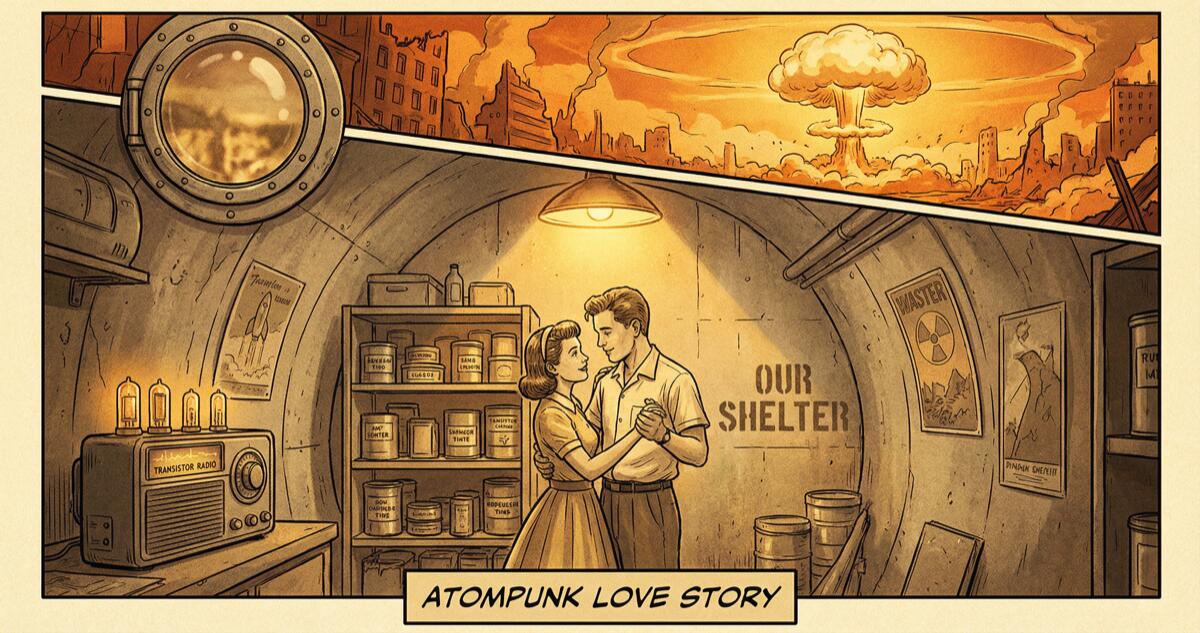
If "Atomic Sunshine" captures the public face of atomic culture, Shelter of Love captures the private one. It's a love song set in a bomb shelter, two people holding each other while the world outside ceases to exist.
"The sirens wail, the bombs may fall / But here with you, I'm safe through it all."
Bomb shelter romance was a genuine cultural trope of the 1950s. Shelter manufacturers marketed their products to newlyweds. Magazine articles debated the ethics of letting your neighbors into your shelter. The bomb shelter became a strange metaphor for intimacy: a sealed space where the outside world, with all its politics and posturing, simply stopped existing.
"Shelter of Love" leans into this with a tenderness that makes the nuclear backdrop feel almost secondary. Almost. The genius of Cold War songwriting is that it never lets you fully forget what's happening outside. The "cozy little shelter of love" is cozy precisely because everything beyond its walls is on fire.
"Bite My Bomb": Cold War Satire Set to Jazz
Bite My Bomb takes a different approach entirely. Instead of hiding from the fear, it laughs directly at it. The song frames the entire USA-USSR nuclear standoff as a dance-off, with Stalin and FDR trading quips over who's going to "light the fuse."
"Bite my bomb, baby, don't you see / I got missiles in my pocket, you got some for me."
This is atomic-age satire at its sharpest, reducing mutually assured destruction to two guys who can't decide who's cooler. The lyrics themselves abandon coherent language at their most intense moments, as if the only sane response to nuclear brinkmanship is to dissolve words entirely into absurdity.
The song ends with a plea for diplomacy: "A world without war, that's where we wanna be." But by that point, the satire has done its work. You've been laughing at something that should make you weep.
"Glow, Baby, Glow!": Leaving Earth as the Bombs Fall
Glow, Baby, Glow! is the most emotionally complex of the Songbirds' nuclear songs. Written later, during the Positronic Mechanicals era, a woman discovers her boyfriend is cheating on her, and simultaneously, the bombs start falling. Her solution? Get on a rocket and leave.
"Atoms split, he split, guess we're all splitsville now."
It's a breakup song, an escape song, and an apocalypse song all at once. The personal betrayal and the global catastrophe mirror each other perfectly. The fear of atomic war becomes indistinguishable from the pain of heartbreak. Both involve a world ending.
The song also captures the space race optimism that ran parallel to Cold War fear. The rocket is both an escape pod from nuclear annihilation and a symbol of the future, a future that might exist somewhere out there, even if Earth doesn't make it.
From Nuclear Fear to AI Anxiety: The Same Existential Song
Here's the thing that keeps pulling me back to Cold War music: it's not really about the past. The atomic age anxiety that produced duck-and-cover drills and bomb shelter romances is the same anxiety we feel today about artificial intelligence. The technology has changed, but the existential fear is identical.
In the 1950s, people worried about a force they'd created but couldn't fully control. They coped with humor, with music, with an almost defiant normalcy. They had picnics at ground zero. Today, we're having the same picnic. We joke about AI taking our jobs while using AI to write our jokes. We build systems we don't fully understand and hope they'll be friendly.
The Mechanical Pioneers era (1937-1960) is our love letter to 1950s atomic culture: the optimism, the dread, the absurdity. But every song about nuclear war or a bomb shelter is also, quietly, a song about right now.
Why Cold War Music Still Matters
The best atomic era songs did more than reflect their time. They anticipated ours. Humanity's relationship with its own creations is always the same story: we build something magnificent, we realize it might kill us, and then we write a catchy tune about it.
That's not cynicism. That's survival. Music doesn't stop the bombs or the algorithms. But it does something the duck-and-cover drills never could: it acknowledges the absurdity while insisting on beauty anyway.
The atomic age never ended. It just got new hardware. And if we're going to live under the shadow of our own inventions, we might as well swing.
So spread out your picnic blanket. Pour something strong. And watch the sky light up.
Atomic sunshine, ain't it neat?