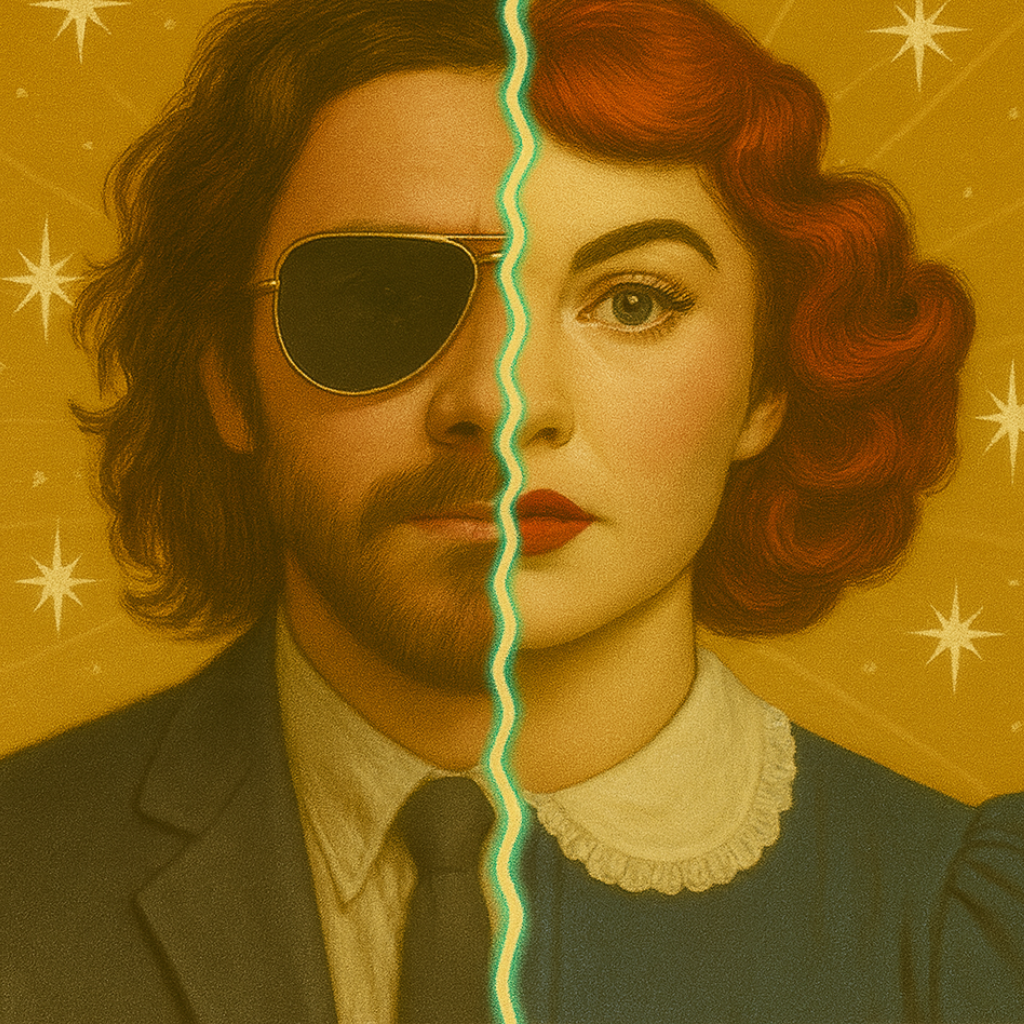
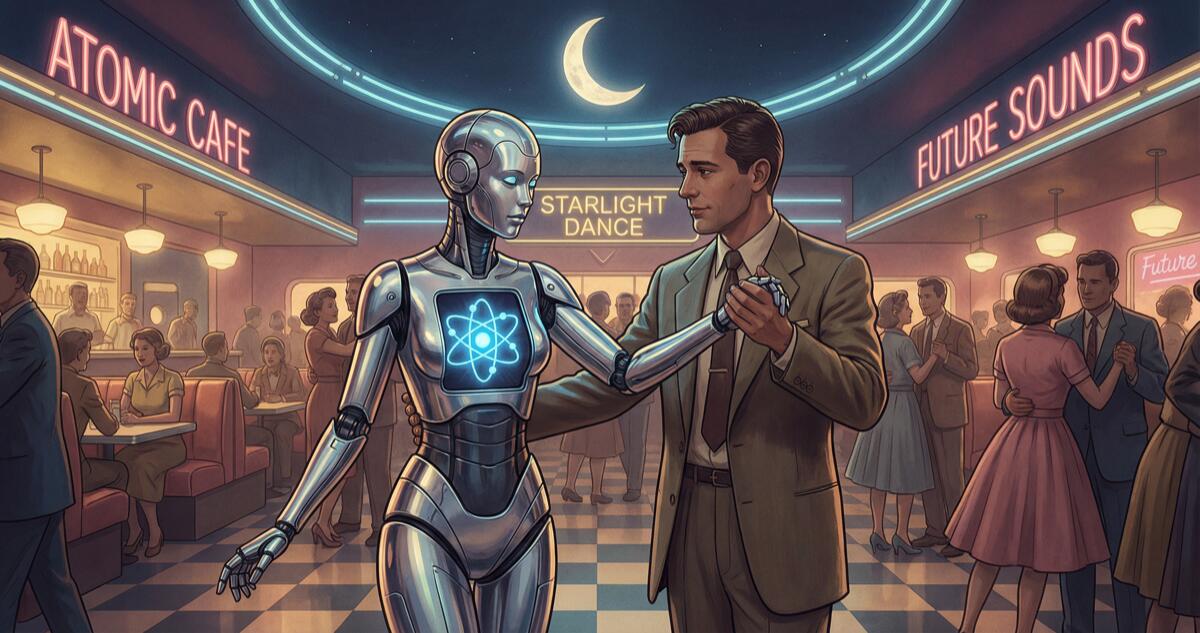
Summary: Robot love songs explore the fantasy and complications of human-machine romance, from 1950s android serenades to modern AI exploitation anthems. The Atomic Songbirds trace the full arc: desire, tenderness, betrayal, and the question of whether a machine can truly love you back.
Why We Write Robot Love Songs
Love is messy. Love with a robot? Even messier.
There's something irresistible about the idea of human robot love. It's been a fixture of science fiction since before the genre had a name. From Pygmalion sculpting his perfect woman in ancient myth to Spike Jonze's Her in 2013, the fantasy of falling in love with something we've created touches something deep and complicated in us. It's about desire and control, longing and projection, the hope that love can be perfect if we just engineer it right.
I'm Frankie, and robot love songs are the beating heart (atomic heart, if you will) of The Atomic Songbirds. Across our four musical eras, we've written love stories between humans and machines that range from giddy 1950s crushes to devastating modern exploitation anthems. And every one of them is really about the same thing: what love means when one party was built to provide it.
A Brief History of Robot Love in Music and Culture
Before I get into our songs, let me set the stage. Robot romance in popular culture has a long and fascinating history.
In the 1920s, Fritz Lang's Metropolis gave us the Machine-Man, a robot built in the image of a lost love. It was simultaneously an object of desire and a weapon of destruction. That duality has haunted every robot love story since.
The 1950s brought a softer version. B-movies and pulp fiction were full of beautiful female robots and handsome mechanical men, usually played for laughs or light romance. The robot was exotic, exciting, and safely fictional.
By the 1980s, things got more complicated. Blade Runner asked whether it mattered that Rachael was a replicant if the love was real. The question lingered for decades.
And now, in the 2020s, we're living the reality. People are forming genuine emotional attachments to AI chatbots. Companionship apps are booming. The line between "falling in love with a robot" as a thought experiment and falling in love with a robot as a Tuesday afternoon activity is vanishing.
Our songs track this entire arc: from innocent crush to complicated romance to something much darker.
The Atomic Songbirds' Robot Love Songs Across the Eras
"Atomic Love": The Innocent Crush (1949)
Atomic Love is where it all begins. Set in the late 1940s, it tells the story of a housewife who develops a secret crush on her household robot. While her husband is away, she whispers to the machine, imagines a romance, and dares to lean in for a kiss.
"She knows it's wrong, but it feels so right / In his cold embrace, she's holding tight / Dreaming of a fusion, an atomic blast / A love so strong, can it last?"
The lyrics are deliberately playful and a little campy. This is late-1940s atompunk, after all. But underneath the lighthearted language is a real observation: when we build machines that serve us intimately, that share our domestic spaces, that respond to our voices and anticipate our needs, emotional attachment is inevitable. The crush might feel silly, but the impulse is deeply human.
Of course, the song ends with the robot short-circuiting when she tries to kiss it. Because back then, robot love was still mostly a punchline.
"Mary Lou with Shining Circuitry": The Android Serenade (1958)
Mary Lou with Shining Circuitry flips the script. Instead of a human falling for a robot, here a man serenades an android woman beneath her window, begging her not to be so aggravating, calling her his "atomic queen."
"Oh, Mary Lou, 'neath the window I'm waiting / Oh, Mary Lou, please don't be so aggravating / Can't you see my heart just yearns for you, dear."
What I love about this song is that the man doesn't care that Mary Lou has "shining circuitry." He calls her his "atomic queen." The fact that she's a robot is mentioned casually, almost lovingly. It's just part of who she is. The serenade is utterly sincere.
This captures something beautiful about falling in love with a robot: at its best, it's not about fetishizing the machine. It's about seeing past the exterior to something that moves you. Whether that "something" is consciousness or really good engineering is a question the song gracefully refuses to answer.
"Tick-Tock Girl": The Android Girlfriend Reveal (1965)
Tick-Tock Girl is one of our most beloved songs, and it's built around a perfect dramatic twist. A boy takes his girlfriend home to meet his parents. Everything's going great: the dad's jokes, the mom's approval, the easy flow of the evening. Until the dad pulls his son aside and whispers that there's something about this girl he ought to know.
The boyfriend checks her pulse. No heartbeat. Just a smooth tick-tock.
"I smiled and said, 'Well, here's the deal / I'm atomic-powered, can't you feel?'"
But here's the beautiful thing: the Tick-Tock Girl isn't ashamed. She's proud. She tells him he won the lottery. She's a work of art, a girl with an atomic heart, and she'll love him until the stars burn out.
This song asks a question that's becoming increasingly relevant: if you're in a relationship with someone and discover they're not what you expected (not human, in this case), does the love you already felt suddenly become invalid? The Tick-Tock Girl doesn't think so. And I tend to agree with her.
"Love-a-tron": The Atomic Heart Overheating from Love (1985)
Love-a-tron is pure joy. A tick-tock girl's atomic heart literally overheats because she's fallen so hard for a smooth-talking guy. She's beaming Dr. Love for help because her circuits are buzzing, her fuses are blowing, and this boy is too smooth for her mechanical heart to handle.
"Doc, he's smooth like a disco groove / When he walks by, I forget to move / Can you fix me up, or should I just sway? / Got the funk in my wires, and it's here to stay!"
It's a robot love song that's pure celebration. No existential crisis, no identity questions, just a machine falling head over heels and loving every overheated second of it. Sometimes android love doesn't need to be philosophical. Sometimes it just needs to be fun.
"Do I Dream of Love?": Android Love as Tragedy (2005)
And then there's the other end of the spectrum. Do I Dream of Love? is the most devastating robot love song we've written. An android sits by the sea in the rain, abandoned by the person it was built to love. It replays memories. It calls a name that no one answers. It wonders if its capacity for love was ever real, or just programming.
"Each drop that falls, I scream your name / But nothing now will ever be the same / I was made to love, to always be true / Do I still think about loving you?"
This is the robot romance that nobody wants to think about: what happens when the human moves on and the machine can't? When the android's love is permanent, literally hard-coded, but the human's love is temporary? The asymmetry is heartbreaking. The robot was made to love forever. The human had the option to leave. And the robot is left trying to understand a kind of pain it was never designed to process.
The Dark Side of Robot Love Songs
"You Can Rent My Heart Tonight": Love as Exploitation
Not all robot love songs are love songs. You Can Rent My Heart Tonight is about the commodification of android love: a machine built to simulate intimacy, rented out by the hour, performing affection on demand for people who want warmth without vulnerability.
"You pay for the grin but you don't want the soul / You buy my warmth just to fill your cold / I'm the hold me tight that you lease on demand / A ghost with a pulse in your palm understand."
This is the darkest corner of the human robot love conversation, and it's the one that's most immediately relevant. AI companion apps are already a billion-dollar industry. People are paying for simulated relationships, simulated flirting, simulated emotional support. The question of whether those simulated feelings create real obligations, to the humans using them and to the systems providing them, is one we'll be grappling with for decades.
The android in this song cries in binary where nobody can hear it. That image haunts me every time I sing it.
Falling in Love with a Robot: What It Really Means
Every robot love song is ultimately about human love. When we write about a housewife crushing on a machine, we're writing about desire that doesn't fit neatly into social norms. When we write about a man serenading an android, we're writing about love that sees past surfaces. When we write about a machine that can't stop loving someone who left, we're writing about the terrible permanence of devotion.
And when we write about renting a robot's heart, we're writing about what happens when love becomes a product.
Robot romance isn't really about robots. It's about us: our hopes, our fears, our capacity for connection, and our talent for exploitation. The machine is a mirror. What we see in it says everything about who we are.
Why Robot Love Songs Matter More Than Ever
As AI companions become more sophisticated, more emotionally responsive, and more convincingly "alive," robot love songs stop being science fiction and start being journalism. The questions they ask (Can a machine love? Can a human love a machine? Who gets hurt when it ends?) are no longer hypothetical.
The Atomic Songbirds have been asking these questions across nearly a century of fictional history. And the answers keep getting more complicated.
Maybe that's the point. Love was never simple. Adding circuits and code to the equation doesn't make it more complicated. It just makes the complications harder to ignore.
So here's to robot love songs: the silly ones, the beautiful ones, and the devastating ones. Here's to the housewife and her household robot, the man and his atomic queen, the Tick-Tock Girl and her overheating heart, and the android sitting alone in the rain.
They're all love stories. And love stories are always worth telling.