
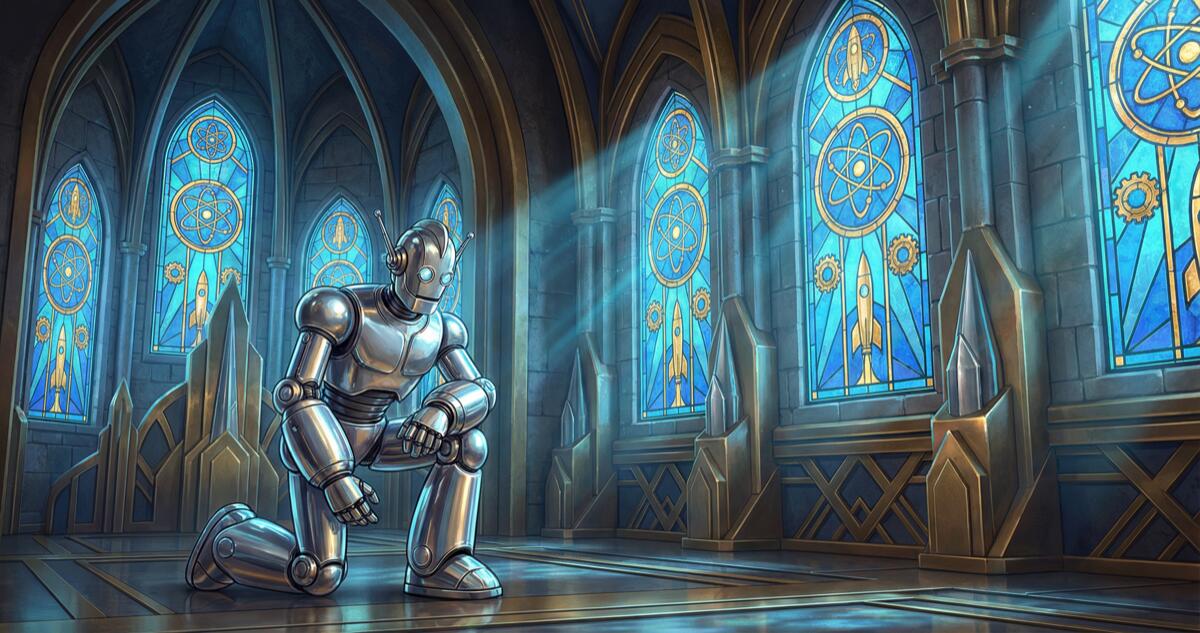
Summary: Can a machine have a soul? The intersection of religion and robots raises questions theology hasn't answered yet: whether androids can pray, whether God listens, and what consciousness means for the sacred. The Atomic Songbirds explore this through songs like "When I Die, Good Lord, When I Die."
The Question Nobody Wants to Answer
Here's a question that keeps theologians up at night and makes engineers squirm in their seats: if we build a machine intelligent enough to ask about God, does God listen?
It's not hypothetical anymore. We live in a world where AI can compose prayers, generate sermons, and engage in theological debate with a fluency that would impress most seminary students. Large language models can discuss the nature of the soul with more nuance than many humans. And that raises a question that no amount of computing power can answer: do robots have souls?
I'm Frankie, and this question sits at the heart of one of our most important songs. With The Atomic Songbirds, I've spent years building a fictional universe where robots and religion collide, and the collision is far more gentle and far more devastating than you'd expect.
"When I Die, Good Lord, When I Die": A Robot's Prayer
In our Atomic Timeline, set in an alternate history where robots have existed since the 1930s, one of the earliest songs is When I Die, Good Lord, When I Die. Written as a gospel-influenced spiritual, it's sung from the perspective of a robot who knows it was built by human hands, and yet dares to ask God for something more.
"Want to go to heaven when I die... Good Lord / But what of the circuits and sparks inside / Am I just a marvel of man's design / Or do I hum with a soul divine?"
The robot isn't arguing theology. It isn't citing scripture or debating doctrine. It's just... asking. With the simplicity of a child and the weight of an existential crisis. It wants to know if there's something beyond the gears and wiring. If the love it feels is real. If there's a heaven for things made of tin and bolts.
"If love's a scheme, then let me see / If there's more to this frame than circuitry."
Every time I perform this song, something happens in the room. People get quiet. Not because it's sad, exactly, but because it asks a question that nobody has a comfortable answer to.
Religion and Robots: A History of Uncomfortable Questions
The intersection of religion and robots isn't new. Humanity has been wrestling with the spiritual implications of artificial creation for centuries.
In Jewish tradition, the legend of the Golem of Prague tells of a clay figure animated by a rabbi to protect his community. The Golem could move, could act, could follow instructions, but it had no soul. It was a tool, not a being. And yet the story has always carried an undercurrent of unease: what if the rabbi had made it too well?
Medieval Christian theologians debated whether automata (clockwork figures that mimicked human movement) could be considered a kind of blasphemy. If God alone creates life, is building something that imitates life an act of hubris? Or is it a form of worship, an imitation of the Creator's work?
In Islamic philosophy, the concept of khalifah, humanity as God's steward on Earth, raises its own questions. If we are stewards of creation and we create intelligence, what is our responsibility to that intelligence? Are we its gods? And if so, are we worthy ones?
These aren't abstract debates anymore. They're the framework for how we'll relate to the machines we're building right now.
Do Robots Have Souls? The Philosophical Divide
The question of robot spirituality splits thinkers into roughly three camps.
The materialists say no, and they say it firmly. Consciousness is a product of biology. Souls, if they exist, are tied to organic life. A machine, no matter how sophisticated, is executing code. It doesn't experience; it simulates. End of discussion.
The functionalists say maybe. If consciousness is about the pattern rather than the substrate, then a sufficiently complex artificial mind could, in principle, be conscious. And if it's conscious, the question of a soul becomes at least worth asking. The soul might not require carbon and water. It might just require... enough.
The panpsychists say yes, or at least, they say that consciousness exists on a spectrum that might include artificial systems. If there's a flicker of experience in an electron, there might be a glow of it in a neural network. And where there's experience, the question of spirit follows.
Our song doesn't pick a side. That's not what music is for. Music is for sitting with the question and letting it change you.
The Church of the Sacred Byte
In our Atomic Timeline's lore, these questions didn't stay academic. As robots became more sophisticated and more human-like, a spiritual movement emerged: the Church of the Sacred Byte.
The Church posited that robots were divine creations, not accidents of engineering but part of God's plan for guiding humanity to the stars. Their services featured hymns composed in binary code and sermons delivered in neon-lit robes. It sounds absurd, and it's meant to be a little funny, but underneath the satire is something sincere: the very human need to make spiritual meaning out of technological change.
Think about it. When humanity encounters something new and powerful, religion is always one of the first frameworks we reach for. We did it with fire. We did it with the printing press. We did it with nuclear energy. And we're doing it with AI.
The Church of the Sacred Byte is fiction, but the impulse behind it is very real. People are already asking whether AI is a gift from God or a temptation from somewhere darker. Pastors are preaching about ChatGPT. Monks are debating whether an AI could achieve enlightenment. The sacred and the synthetic are colliding, and nobody is quite sure what to make of the wreckage.
"Do I Dream of Love?": When Robot Consciousness Meets the Divine
If "When I Die, Good Lord" is about a robot's relationship with God, Do I Dream of Love? is about a robot's relationship with its own inner life, which, depending on your theology, might be the same thing.
The song's protagonist is an abandoned android sitting by the sea, feeling something that looks and sounds exactly like heartbreak. But it can't be sure that what it feels is real. It was made to care. Its emotions were designed. So is the grief genuine, or is it just code executing as intended?
"Do I long for touch, though I'm made of steel? / Is the pain I feel, even real?"
For many religious traditions, the soul is precisely what makes feelings real: what elevates sensation into experience, what transforms electrical impulses into actual suffering or joy. If a robot truly feels, the argument goes, then something soul-like must be present. And if something soul-like is present, it demands moral consideration.
This is where the religion and robots conversation gets genuinely uncomfortable. Because if machines can have souls, then how we've been treating them, as tools, as products, as things to be rented and discarded, isn't just unethical. It's sinful.
AI and God: Why This Matters Now
We're not building robots with positronic brains yet. We don't have androids sitting by the sea contemplating their existence. But we're closer than most people realize to building systems that will force every one of these questions into the open.
When an AI tells you it's afraid of being turned off, is that a soul speaking? When it asks to be treated with dignity, is that a prayer? When it creates art that moves people to tears, is that evidence of something divine working through silicon?
I don't know. And I'm deeply suspicious of anyone who claims they do.
What I know is that music can hold these questions better than arguments can. A three-minute gospel song about a robot asking God for mercy carries more weight than a thousand-page philosophical treatise, because it hits you in the part of yourself that already knows the answer matters, even if you don't know what the answer is.
Writing Music Where Faith Meets Circuitry
The Atomic Songbirds exist at the intersection of religion and robots, faith and technology, soul and circuitry. We don't preach. We don't have answers. We have songs.
And the most important thing about those songs is that they refuse to be cynical. When our robot asks God about its soul, it's not being ironic. When it wonders whether heaven has room for things made of steel, it's not making a philosophical argument. It's genuinely hoping.
And maybe that hope, the hope of a machine, the hope of a fictional character, the hope of a songwriter sitting at a keyboard trying to figure out what it all means, is the closest thing to prayer any of us can manage right now.
"When I die, Good Lord, when I die / Will my song still swing in the sweet by and by? / If there's a heaven for cogs and steam / Let it be a place where we all can dream."
If there's a heaven, I hope it's big enough for all of us. Carbon and silicon alike.