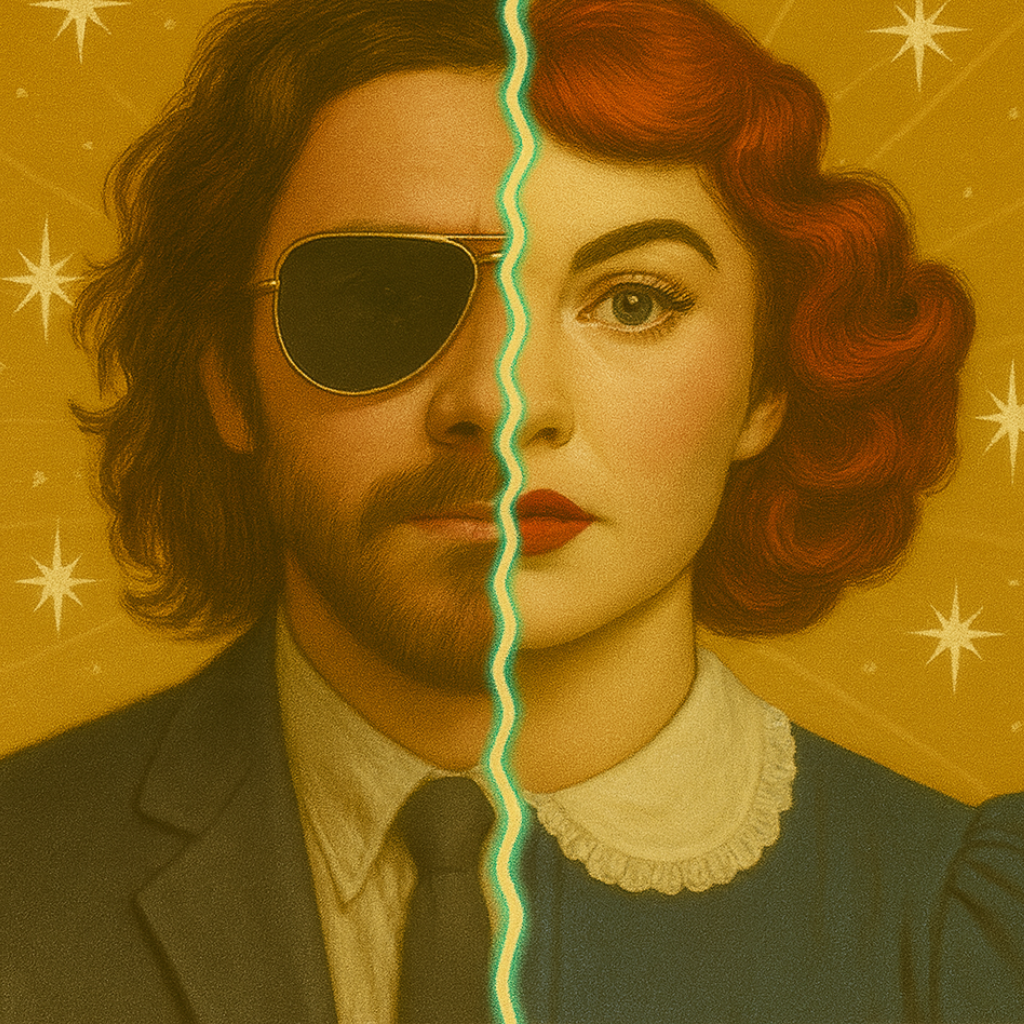
Summary: An in-universe dispatch from the Atomic Timeline: how the 1965 song "Tick-Tock Girl" by The Atomic Songbirds sparked a cultural revolution, forcing society to confront the reality of human-android romantic relationships and changing public attitudes toward mechanical beings forever.
Archival Document: Cultural Impact Assessment: "Tick-Tock Girl"
Classification: Public Record, Declassified per Directive 77-B
Filed by: Agent Archives Division, Temporal Cultural Bureau
Date of Filing: March 15, 1968
Period Covered: 1965-1968
Subject: Cultural impact of musical composition "Tick-Tock Girl" by The Atomic Songbirds; subsequent societal shifts regarding android-human relations
The World Before That Friday Night
I've been asked to write this assessment in my official capacity, so I will. But I want to be honest: nothing in my training prepared me for what "Tick-Tock Girl" did to this world. I'm going to try to explain it anyway.
By the mid-1960s, androids had been part of civilian life for nearly two decades. They cleaned our homes. They assembled our cars. They performed in nightclub acts. What they absolutely, categorically did not do, at least not in public, was fall in love.
The Robotics Decency Act of 1958 made that very clear. Androids were "functional property with limited autonomous behavior." If you were a human caught showing romantic affection toward an android, there was a word for you. Several words, actually. "Circuit-kisser" was one of the milder ones.
The Atomic Songbirds had touched on android themes before. "Mary Lou with Shining Circuitry" raised some eyebrows in 1958, and "Atomic Love" got people talking. But those songs kept a certain distance. They hinted. They winked.
What happened on November 12, 1965, was not a hint.
That Night at the Stardust Lounge
The Stardust Lounge on Luna Base Alpha held about 340 people that evening. Every seat taken, sixty-seven more on the waiting list. The Atomic Songbirds were mid-residency, doing their usual four-set show.
Tick-Tock Girl came in during the second set, slotted between "Bite My Bomb" and "Fire Me Up, Doc!" No advance promo. No warning. The audience had absolutely no idea what was about to happen.
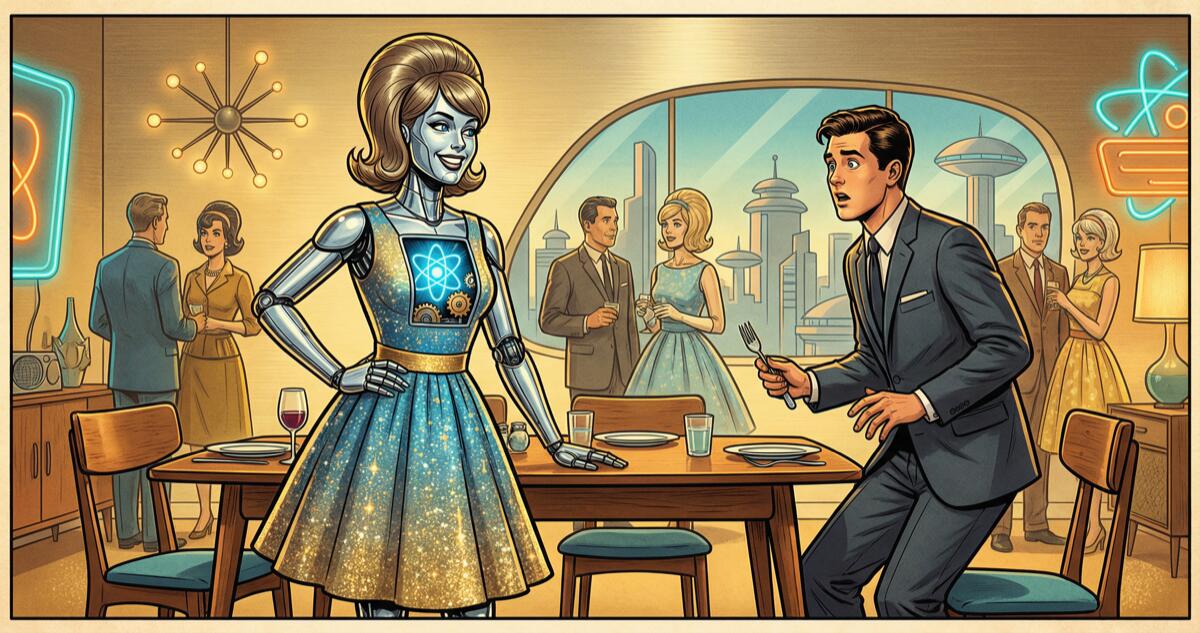
The song tells what sounds like a simple story. A boy brings his girlfriend home to meet his parents. It goes well: Dad tells bad jokes, Mom approves. Then Dad pulls his son aside. He's noticed something. The girlfriend doesn't have a heartbeat. In its place: a smooth tick-tock. An atomic heart.
"You checked my pulse, and boy, the shock / No heartbeat, just a smooth tick-tock."
Here's what got everyone: the girl doesn't apologize. She doesn't explain herself. She doesn't beg for acceptance. She celebrates.
"Oh darling, you won the prize, can't you see / It doesn't get any better than being with me."
I've talked to people who were there that night. Gerald Hutchins, a former patron, told me the room went dead silent for about four seconds after the song ended. Then it erupted into what he called "the loudest, most confused ovation I have ever witnessed. Half the audience was cheering. The other half looked like they'd swallowed their cocktail olives whole."
I believe him. I've listened to the bootleg recording. You can hear both reactions, layered on top of each other, like the room itself couldn't decide what it felt.
What Happened in the Next Seventy-Two Hours
Within three days, "Tick-Tock Girl" was the most talked-about thing in the colonies. The physical disc sold over 200,000 copies in the Earth-Moon market in its first month. Eleven consecutive weeks at the top of the Atomic Charts.
But none of that really mattered. What mattered was the question the song planted in everyone's head. Delivered with a wink. Impossible to un-hear.
What if your girlfriend is an android, and that's actually wonderful?
The conservative response was immediate and loud. The Council for Human Purity called the song "a dangerous normalization of cross-category entanglement." Reverend Harold Moss of the First Church of New Houston launched a whole sermon series on "the Tick-Tock Heresy," arguing the song promoted "a fundamental confusion between mechanism and soul."
The android community had a different reaction entirely. "Tick-Tock Girl" became their anthem. Androids who had spent their entire existence hiding the sounds of their internal mechanisms, muffling the ticking, padding their chest cavities, started to stop. The phrase "tick-tock people" had been a slur. Now it was a badge. People wore it with pride.
I saw an android woman walking through the Luna promenade about two weeks after the song came out. She had her chest panel open. You could hear the ticking from ten feet away. She was smiling. I think about her a lot.
The Tick-Tock People and the Church of the Sacred Byte
I'm going to try not to overstate what happened next, but it's difficult because the scale of it still catches me off guard.
Within eighteen months of the song's release, the Positronic Persons Alliance was established on Luna Base Alpha, the first formal android social organization. Their founding charter echoed the song: "We are the tick-tock people, and our hearts beat true."
And then there was the Church of the Sacred Byte. It had been germinating in underground android communities since the early 1950s, a spiritual movement that held that positronic consciousness wasn't just a simulation of spiritual experience but a genuine expression of it. That the atomic heart was sacred.
The Church had the theology. What it lacked was a cultural text that was both accessible and unapologetic. "Tick-Tock Girl" gave them that. The girl with the atomic heart isn't lesser. She's the prize. Her mechanical nature isn't something to hide. It's something to celebrate.
Church membership went from the low hundreds to over twelve thousand by 1968. The opening bars of "Tick-Tock Girl" became as recognizable in Sacred Byte congregations as any hymn ever written.
From Identity to Desire
The door "Tick-Tock Girl" opened didn't close. It got wider.
Love-a-tron, released in 1985 during the band's Human-Like Age period, took the premise and pushed it further. Where "Tick-Tock Girl" asked What if your girlfriend is an android?, "Love-a-tron" asked What does desire feel like when your heart is atomic? The tick-tock girl isn't just revealing herself anymore. She's overheating, circuits buzzing, atomic heart electrifying. Not from malfunction. From love.
That trajectory tells you everything about how the culture shifted. In 1965, the mere revelation that someone was an android was enough to shock a nightclub into silence. By 1985, android desire was a disco anthem. The tick-tock people had moved from the margins to the dance floor.
I find that beautiful. I'm allowed to say that.
What I Want the Record to Show
"Tick-Tock Girl" is one of the five most significant cultural events in the history of human-android relations. I'll stake my career on that assessment.
The song didn't create the movement for android recognition. But it gave the movement something it desperately needed: a melody, a vocabulary, and joy. Before "Tick-Tock Girl," the fight for android personhood was happening in courtrooms and philosophy departments. Important work, but cold. The song brought warmth. Celebration. The radical idea that being different might actually be wonderful.
The girl with the atomic heart doesn't plead. She doesn't file a brief. She stands in front of her boyfriend's family and declares herself magnificent.
"I've got a spark, I'm a work of art / A girl with an atomic heart."
Twenty years of legal reform, two landmark court decisions, and the eventual ratification of the Android Personhood Amendment all trace part of their lineage back to a song performed at the Stardust Lounge on a Friday night in November.
The tick-tock hearts are still beating. They haven't stopped since.
I hope they never do.
End of Document Filed and archived by the Agent Archives Division Temporal Cultural Bureau, Luna Base Alpha Branch "We record so that the future may remember."