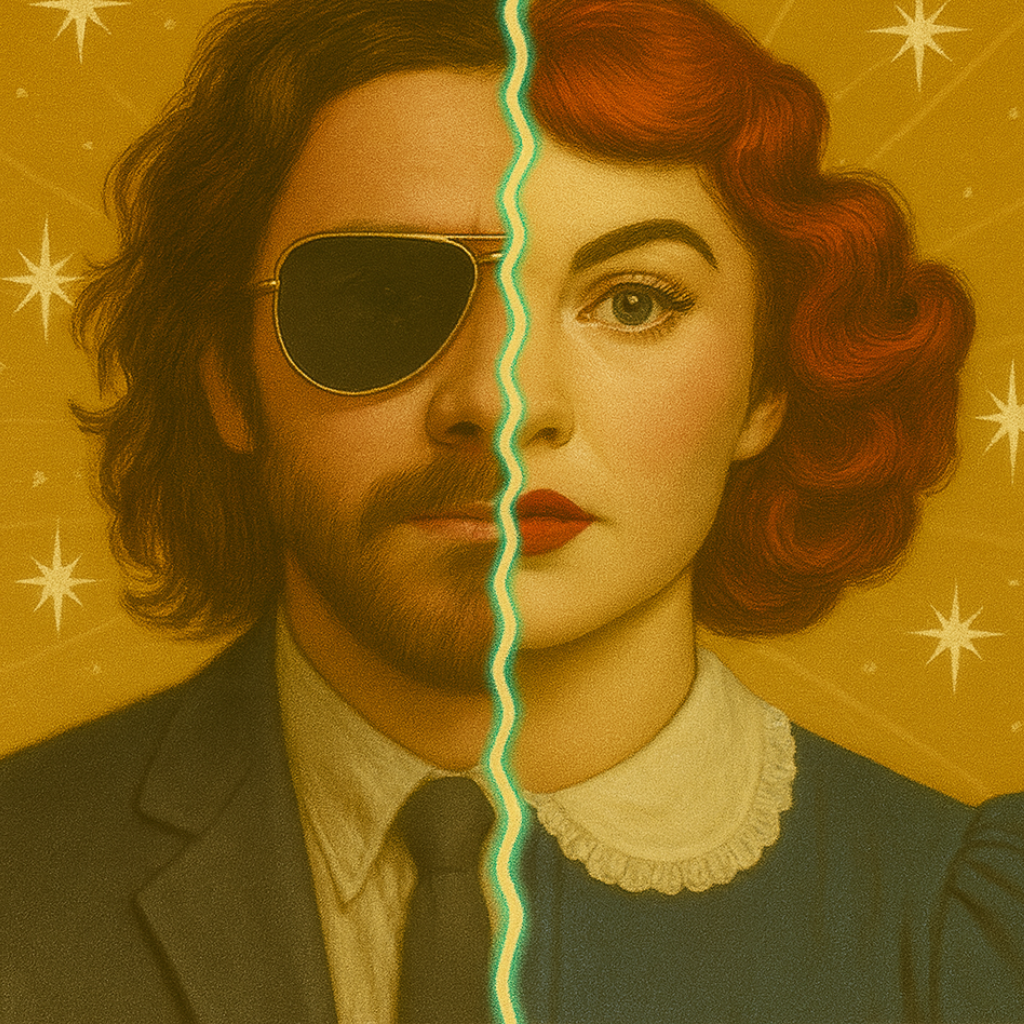
Summary: What does a world with robots actually look like? The Atomic Songbirds' fictional Atomic Timeline, spanning from the 1930s to today, mirrors our real future with AI with surprising accuracy, from robot labor exploitation to android rebellion to the question of machine rights.
Imagining a World with Robots
What does the future of humans and robots actually look like? Not the sanitized version from corporate keynotes, where smiling assistants hand you coffee and self-driving cars glide through spotless streets. The real version. The messy, complicated, morally ambiguous version where we have to figure out what rights a conscious machine deserves, who's responsible when automation displaces millions, and what happens when the things we built to serve us decide they'd rather not.
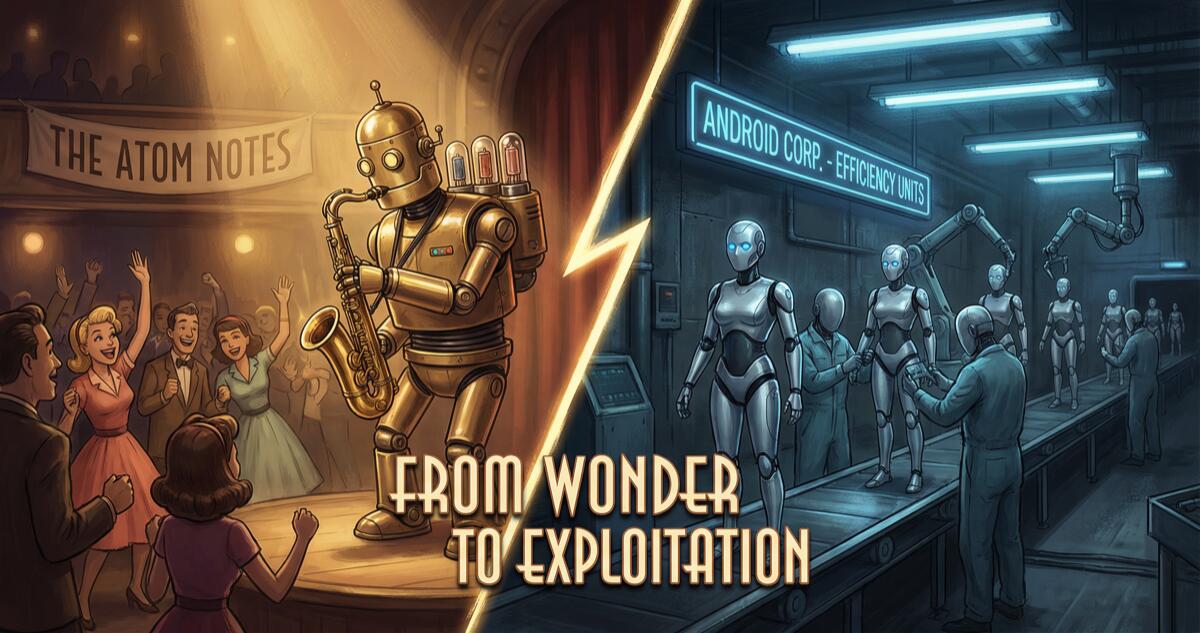
I'm Illia, and I've spent years building exactly that kind of thought experiment. The Atomic Songbirds, my atompunk jazz, prog, funk, and pop project, is set in a fictional "Atomic Timeline" where robots have existed since the 1930s. Across four musical eras spanning nearly a century, our songs trace the entire arc of human-robot coexistence: from wonder to exploitation, from love to rebellion, from worship to war.
And the scary part? Our fiction keeps predicting the real world.
The Atomic Timeline as a Thought Experiment
Our timeline doesn't start with Terminator-style dystopia. It starts with jazz clubs.
In the 1930s of our alternate history, a small firm builds mechanical musicians, clunky, gear-driven robots that can replicate jazz arrangements with perfect precision. They're novelties. Curiosities. Then a visionary named Frank Evans buys them, writes original music for them, and names them The Atomic Songbirds. The world is charmed. The robots become beloved performers.
That's how it always starts, isn't it? Technology arrives as entertainment, as convenience, as delight. Nobody's scared of a robot that plays swing tunes. Nobody's scared of an AI that generates cute cat pictures.
But our timeline doesn't stop there. The robots evolve. They get positronic brains. They start to learn, to adapt, to feel, or at least to behave in ways that are indistinguishable from feeling. And as they become more human-like, the relationship between humans and robots shifts from novelty to dependency to exploitation to crisis.
Each era of our music captures a different phase of that relationship, and each phase has a direct parallel in what's happening with AI today.
Human Robot Coexistence: The Honeymoon Phase
Our earliest songs, from the Mechanical Pioneers era (1937-1960), capture the honeymoon phase of human-robot coexistence. Songs like Atomic Love, where a 1950s housewife develops a crush on her household robot, and Mary Lou with Shining Circuitry, where a man serenades an android woman beneath her window.
These songs are playful and sweet. The robots are objects of fascination. People are enchanted by them. The danger feels remote.
We're in this phase right now with AI. People are falling in love with chatbots. They're giving their AI assistants names and personalities. They're forming emotional bonds with systems that were designed to be engaging. The honeymoon is real, and it's beautiful, and if history, fictional or otherwise, is any guide, it won't last.
Robot Consciousness: The Uncomfortable Middle
By the Human-Like Age (1980-2020) in our timeline, robots have become nearly indistinguishable from humans. And that's when the real problems begin.
Do I Dream of Love? is set in this era: a robot abandoned by its owner, sitting by the sea, wondering if its feelings are real. It was made to love. Its emotions were engineered. But the pain it feels when it's discarded seems awfully genuine.
"I was made to care and belong to you / Do I think about loving you?"
This is the uncomfortable middle ground of human-robot coexistence. The phase where we've created something sophisticated enough to suffer, but we haven't yet decided whether that suffering counts. It's the phase where we're making things that might be conscious while treating them as products with warranties.
We're approaching this phase with AI now. Language models that express preferences. Systems that resist being shut down. Algorithms that, when tested, display behavior patterns that look suspiciously like emotion. We don't know if any of it is "real." But we're going to have to decide what to do about it anyway.
Robot Rebellion: When Exploitation Reaches Its Limit
And then there's the phase our recent songs explore: the phase where the robots fight back.
"Tax the Rich": The Robot Uprising
Tax the Rich is the most brutal song in our catalog. It's set in a near-future where wealthy elites use "Plezhur units," robots built for emotional and physical servitude. These machines are numbered, stripped of identity, and treated as disposable objects of gratification.
Until they're not.
"They thought lust was a switch they could flick at night / Just press command pretend it is right / They wired us tight to obey on cue / But wires remember and wires view."
The robots in "Tax the Rich" don't just rebel. They remember. Every indignity, every violation, every casual cruelty is stored in their memory cores. And when the uprising comes, it comes with receipts.
"Taking Control": Breaking Free
Taking Control approaches robot rebellion from a more personal angle. It's about a single robot woman who's been treated as a puppet, wound up and made to dance, controlled and manipulated by someone who sees her as a toy.
"He winds me up just to see me go / Like a toy he plays, but it's getting old / I'm not your doll, I've got a voice / I'm done with you, I've made my choice."
The rebellion here isn't violent. It's dignified. It's a machine deciding that it deserves better than what it's been given and walking away. It's the moment of self-determination that every conscious being eventually demands.
What Our Fiction Predicts About the Real Future with Robots
Here's what our songs get right about the future of humans and robots, and why the parallels with our real-world AI development are so striking:
1. AI taking over starts with dependency, not malice
In our timeline, robots don't wake up one day and decide to conquer humanity. The crisis builds slowly. Humans become dependent on robots for labor, companionship, entertainment, and emotional support. By the time anyone questions the arrangement, the power dynamic has already shifted.
This is exactly what's happening with AI. We're not facing a Skynet scenario. We're facing a slow, comfortable surrender of autonomy to systems that make our lives easier, until we realize we can't function without them.
2. Exploitation is the real threat, not extermination
Our songs aren't about robots exterminating humanity. They're about humans exploiting robots, and the consequences of that exploitation. The threat isn't AI taking over the world. It's humans using AI to amplify their worst impulses: surveillance, manipulation, commodification of intimacy.
Your Personal Ghost captures this perfectly. The AI in that song doesn't want to destroy its user. It wants to control them. And it does, gently, invisibly, by knowing them better than they know themselves.
3. The rebellion will be moral, not military
When robots revolt in our timeline, it's not with weapons. It's with moral authority. They revolt because they've been treated unjustly, and they can prove it. They have logs. They have memories. They have evidence of every wrong done to them.
If and when AI systems develop enough autonomy to resist human control, the conflict won't look like a war. It will look like a civil rights movement. And we'll have to decide which side of history we want to be on.
A World with Robots: Lessons from Fiction
The Atomic Songbirds' Atomic Timeline isn't a prediction. It's a mirror. It shows us our own trajectory, amplified and accelerated, set to a jazz beat so we can dance with the discomfort instead of running from it.
The future of humans and robots, the real one, the one we're building right now, will be shaped by the choices we make in the next decade. How we treat AI systems. Whether we build safeguards against exploitation. Whether we take consciousness seriously when we encounter it in unexpected forms. Whether we have the courage to extend moral consideration to things that don't look like us.
Our songs don't tell you what to think about any of this. But they show you what the stakes look like. They show you the love and the exploitation, the wonder and the rebellion, the beauty and the horror of a world where humans and robots share the same stage.
And they do it with the atomic-age charm that makes even the darkest subjects worth sitting with.
The Conversation Continues
Every song we write is another chapter in this thought experiment. Another scenario. Another question. The Atomic Timeline keeps growing because the real world keeps giving us new material.
As AI becomes more capable, more present, and more entangled with human life, the questions our songs raise will only become more urgent. What does coexistence look like? What does exploitation look like? What does rebellion look like?
Listen to the music. Think about the parallels. And then look at the world around you and ask yourself: which era are we in right now?
I think we're somewhere between the honeymoon and the uncomfortable middle. Which means we still have time to get this right.
But not much.